

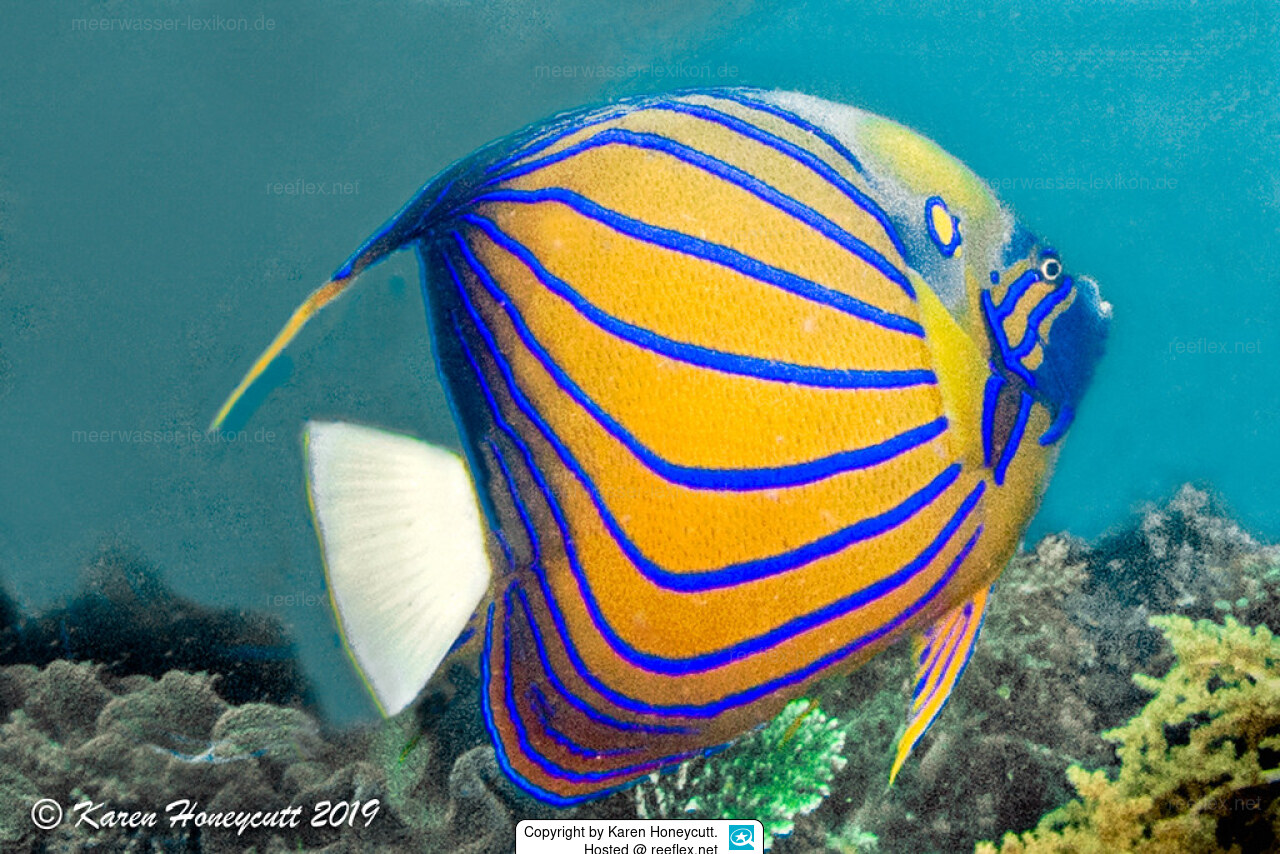
 Karen Honeycutt, USA


Info
(Bloch, 1787)
Pomacanthus annularis also known as the Blue-ringed Angelfish and Annularis Angelfish is found in the Central Indian Ocean to West Pacific; west coast of India, Sri Lanka, Southeast Asia, southern Ryukyu Islands, Taiwan, Philippines, Papua New Guinea to Solomon Islands. Pomacanthus annularis will be seen alone in its juvenile stage, while adults are usually observed in pairs. Its natural habitat is coastal and coral reefs at depths of 3 - 50 meters.
The Blue-ringed Angelfish is overall black with alternating white and blue curved well-spaced stripes on the sides. Adults are golden brown or orange with well-spaced curved horizontal stripes radiating from the pectoral-fin base area, running along the sides towards the posterior portion of the dorsal fin. Two similar blue stripes run horizontally across the face, one running through the eye, from above the snout to the edge of the operculum. A blue ring is behind and slightly above the edge of the operculum. Caudal fin is white with bright yellow margin.
In captivity Pomacanthus annularis will nip the polyps of both hard and soft corals as well as inverts like live shrimps, it is best kept in a fish only community aquarium but BETTER LEFT IN THE OCEAN. Unfortunately, Pomacanthus annularis can become quite belligerent, possibly bullying more passive tank mates such as butterflyfish, batfish, and trunkfish. In the wild, Pomacanthus annularis feeds on algae, sponges, zooplankton, coral polyps, shrimp and shellfish. As adult angelfish develop a dependence on sponges.
Synonyms:
Chaetodon annularis Bloch, 1787
Pomacanthodes annularis (Bloch, 1787)
Classification: Biota > Animalia (Kingdom) > Chordata (Phylum) > Vertebrata (Subphylum) > Gnathostomata (Superclass) > Pisces (Superclass) > Actinopterygii (Class) > Perciformes (Order) > Pomacanthidae (Family) > Pomacanthus (Genus) > Pomacanthus annularis (Species)
hma