

 Biodiversity Data Journal

Info
Countless crustaceans inhabit the northern oceans. They are one of the largest groups of marine invertebrates and form the foundation of food chains. In some places, the biomass of certain crustacean species exceeds the combined biomass of all other animals.
Crustaceans include planktonic mysidaceans and euphausiaceans (also known as krill) and serve as the primary food source for whales and many fish. They also include numerous amphipods and isopods, which clean the ocean by consuming all the dead organic matter on the seafloor, thereby playing a vital role in marine communities.
There is a vast number of amphipods, both in terms of species diversity and biomass—the total number of individuals. They live in every conceivable habitat: in the littoral zone and at depths of many kilometers, in freshwater and hydrothermal vents, in deep caves, and even on the forest floor, where they can easily escape the wet leaf litter and move freely across the ground.
About 10,000 species of amphipods have been officially described, but this is certainly only the beginning of a very long list. They are also very widespread in the northern seas, where they occupy a variety of ecological niches. Then there are parasitic amphipods that control the populations of jellyfish and other jellyfish-like organisms, as well as crabs, shrimp, lobsters, and many others.
These animals are important not only for the health of the oceans but also for the people whose lives have been tied to marine fisheries for centuries.
The family Scinidae comprises small to medium-sized crustaceans ranging in length from 2.5 to 30 mm (excluding antennae).
The body is slightly flattened dorsoventrally, smooth or bearing a flat dorsal keel (genus Scina), or armed with strong spines and keels (genera Ctenoscina, Spinoscina, Acanthoscina). Among the Hyperiidea, this family is the most species-rich.
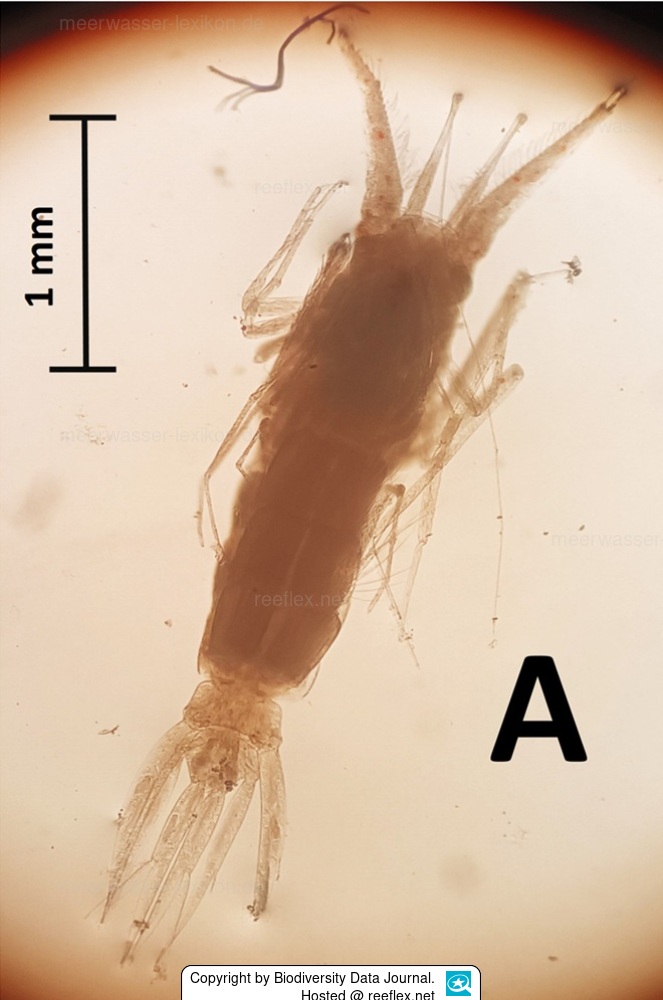
Scina nana is such an amphipod; its body is smooth and without keels, and its antennas are robust and as long as the pereon or slightly shorter than it.
The second segment of the pereopods V is armed with long, curved teeth along its posterior margin; the anterior margin of the segment is smooth and bears only one or two large teeth at the base of the short distal process; the fourth segment is slightly shorter than the second and about twice as long as the fifth, which in turn is slightly longer than the sixth segment; the claw is very small.
Scina nana is relatively rare and occurs mainly in the tropical regions of all the world’s oceans; it was recorded in 2026 in the Mediterranean Sea in the coastal waters of Syria.
Anomaly: The species was also discovered in the cold waters of the Southern Ocean off the West Ice Shelf!
Citation:
Hasan H, Zeini A, Mayya W (2026) First record of Scina nana Wagler, 1926 (Crustacea, Amphipoda, Hyperiidea) in Mediterranean Sea from the northern coastal waters north of Syria (eastern Mediterranean). Biodiversity Data Journal 14: e199166. https://doi.org/10.3897/BDJ.14.e199166
This is an open access article distributed under the terms of the Creative Commons Attribution License (CC BY 4.0), which permits unrestricted use, distribution, and reproduction in any medium, provided the original author and source are credited.
Crustaceans include planktonic mysidaceans and euphausiaceans (also known as krill) and serve as the primary food source for whales and many fish. They also include numerous amphipods and isopods, which clean the ocean by consuming all the dead organic matter on the seafloor, thereby playing a vital role in marine communities.
There is a vast number of amphipods, both in terms of species diversity and biomass—the total number of individuals. They live in every conceivable habitat: in the littoral zone and at depths of many kilometers, in freshwater and hydrothermal vents, in deep caves, and even on the forest floor, where they can easily escape the wet leaf litter and move freely across the ground.
About 10,000 species of amphipods have been officially described, but this is certainly only the beginning of a very long list. They are also very widespread in the northern seas, where they occupy a variety of ecological niches. Then there are parasitic amphipods that control the populations of jellyfish and other jellyfish-like organisms, as well as crabs, shrimp, lobsters, and many others.
These animals are important not only for the health of the oceans but also for the people whose lives have been tied to marine fisheries for centuries.
The family Scinidae comprises small to medium-sized crustaceans ranging in length from 2.5 to 30 mm (excluding antennae).
The body is slightly flattened dorsoventrally, smooth or bearing a flat dorsal keel (genus Scina), or armed with strong spines and keels (genera Ctenoscina, Spinoscina, Acanthoscina). Among the Hyperiidea, this family is the most species-rich.
Scina nana is such an amphipod; its body is smooth and without keels, and its antennas are robust and as long as the pereon or slightly shorter than it.
The second segment of the pereopods V is armed with long, curved teeth along its posterior margin; the anterior margin of the segment is smooth and bears only one or two large teeth at the base of the short distal process; the fourth segment is slightly shorter than the second and about twice as long as the fifth, which in turn is slightly longer than the sixth segment; the claw is very small.
Scina nana is relatively rare and occurs mainly in the tropical regions of all the world’s oceans; it was recorded in 2026 in the Mediterranean Sea in the coastal waters of Syria.
Anomaly: The species was also discovered in the cold waters of the Southern Ocean off the West Ice Shelf!
Citation:
Hasan H, Zeini A, Mayya W (2026) First record of Scina nana Wagler, 1926 (Crustacea, Amphipoda, Hyperiidea) in Mediterranean Sea from the northern coastal waters north of Syria (eastern Mediterranean). Biodiversity Data Journal 14: e199166. https://doi.org/10.3897/BDJ.14.e199166
This is an open access article distributed under the terms of the Creative Commons Attribution License (CC BY 4.0), which permits unrestricted use, distribution, and reproduction in any medium, provided the original author and source are credited.


