


 Dan Schofield, UK


Info
Nanuca sebastiani Er. Marcus, 1957
The holotype of this species was collected in Recife, Pernambuco State, Brazil. The specific epithet sebastiani honours Sebastian Gerlach, who collected the type material and was a colleague of Ernst Marcus, the author of the species.
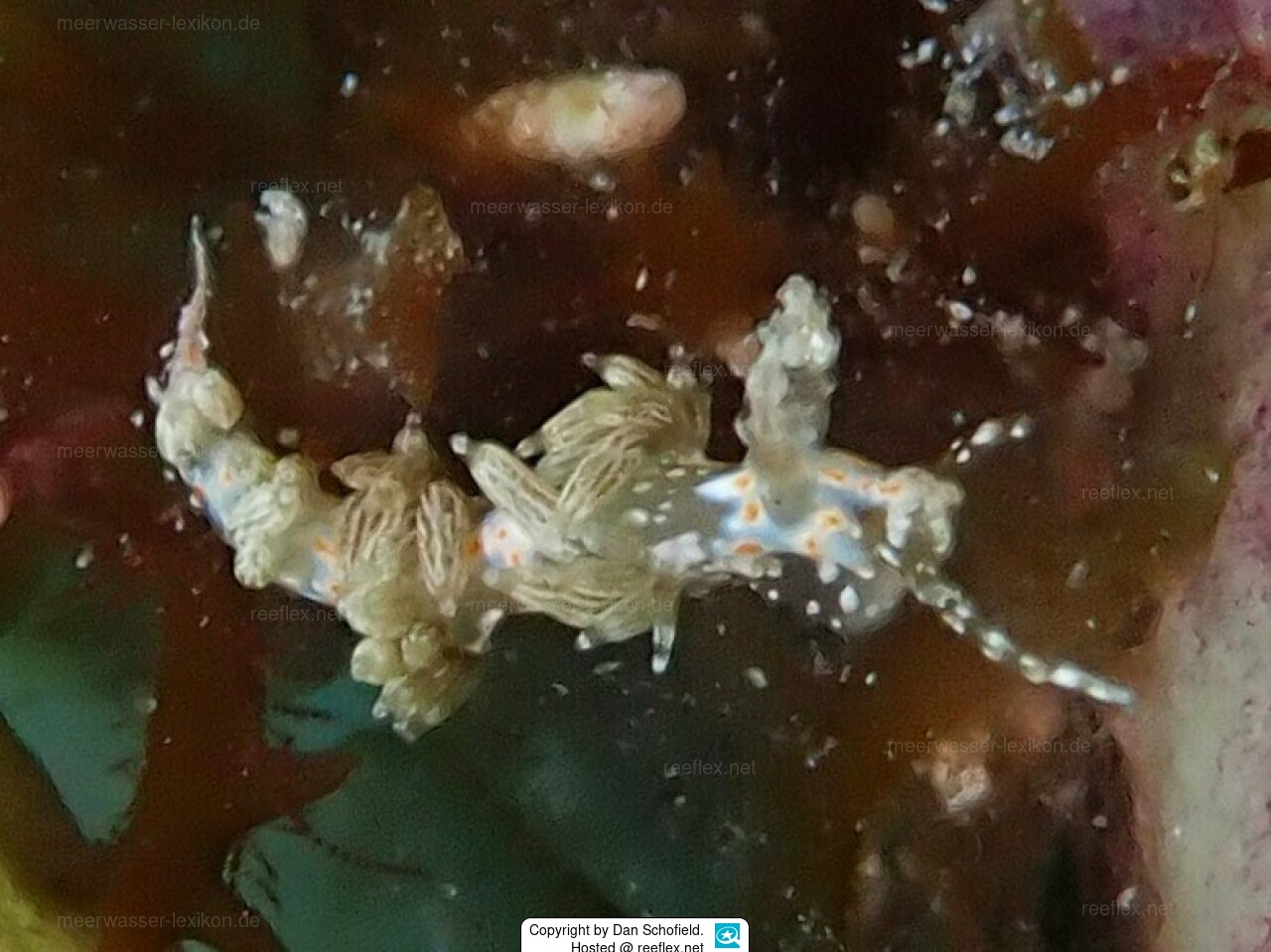
The body is translucent greenish, overlaid by a characteristic pattern of white patches, each typically bearing a central yellow spot or line. This pigmentation comprises a series of patches along the dorsal midline: two in front of the rhinophores, one between them, two between the rhinophores and the first ceratal cluster, three between the first and second clusters, three between the second and third, one between the third and fourth, and three behind the last cluster, accompanied by lateral extensions forming cruciform patterns.
The oral tentacles bear banded cream-white markings, while the rhinophores have a cream-white coating on their upper half and three or four notched, upwardly folded rings. The cerata, arranged in four clusters on each side, are cylindrical, with thin cream-white longitudinal lines on their walls ending in translucent white tips.
The aeolid Nanuca sebastiani is a poorly documented species. Members of the genus are specialist feeders on particular hydroid polyps. The exact diet of Nanuca sebastiani is unknown.
Whereas Nanuca sebastiani remained the only species of its genus for many decades after its description in 1957, five new species were described in 2025.
Synonymised names:
Dondice sebastiani (Er. Marcus, 1957)
Nanuca sebastiana [sic] (misspelling)
The holotype of this species was collected in Recife, Pernambuco State, Brazil. The specific epithet sebastiani honours Sebastian Gerlach, who collected the type material and was a colleague of Ernst Marcus, the author of the species.
The body is translucent greenish, overlaid by a characteristic pattern of white patches, each typically bearing a central yellow spot or line. This pigmentation comprises a series of patches along the dorsal midline: two in front of the rhinophores, one between them, two between the rhinophores and the first ceratal cluster, three between the first and second clusters, three between the second and third, one between the third and fourth, and three behind the last cluster, accompanied by lateral extensions forming cruciform patterns.
The oral tentacles bear banded cream-white markings, while the rhinophores have a cream-white coating on their upper half and three or four notched, upwardly folded rings. The cerata, arranged in four clusters on each side, are cylindrical, with thin cream-white longitudinal lines on their walls ending in translucent white tips.
The aeolid Nanuca sebastiani is a poorly documented species. Members of the genus are specialist feeders on particular hydroid polyps. The exact diet of Nanuca sebastiani is unknown.
Whereas Nanuca sebastiani remained the only species of its genus for many decades after its description in 1957, five new species were described in 2025.
Synonymised names:
Dondice sebastiani (Er. Marcus, 1957)
Nanuca sebastiana [sic] (misspelling)


